
How to Run Your Entire B2B Marketing on LinkedIn (5-Step System)
B2B Marketing on LinkedIn: The Full-Funnel System

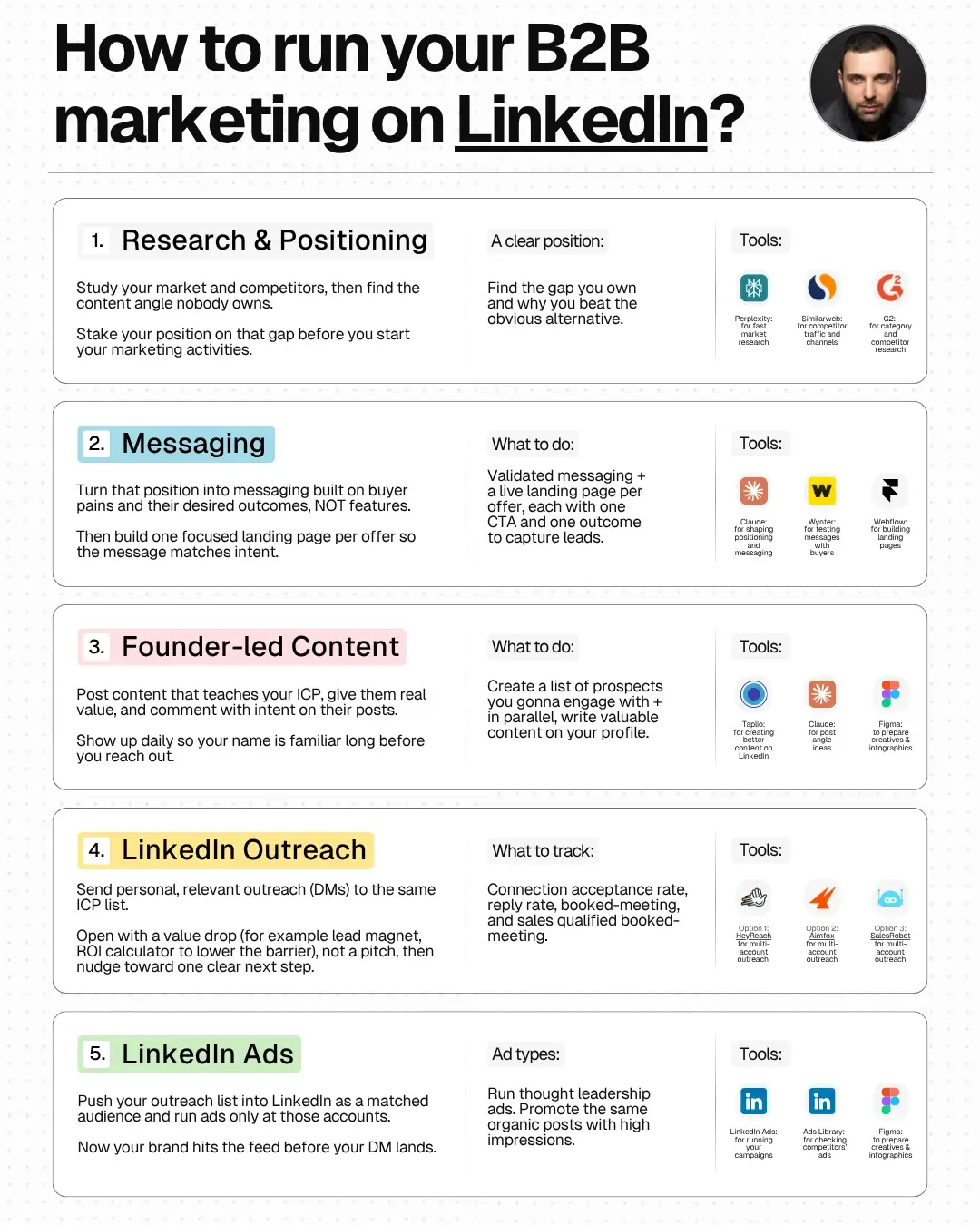
You can run a complete B2B marketing funnel on LinkedIn alone, from market research to booked meetings, with one five-step system: research and positioning, messaging, founder-led content, outreach, and ads.
The move most teams miss is stacking the last three layers on the same buyer list, at the same time, so they compound instead of running as separate campaigns.
That matters because the whole funnel already lives on one platform. Around 80% of B2B leads sourced from social media come from LinkedIn, and four out of five members there drive business decisions at their companies. Your buyer researches, reads, and decides in the same feed. So you can too.
Most companies still use LinkedIn for a single job: outreach, or personal branding, or ads. The teams that win run all of it as one connected motion.
In this post you'll learn the exact five steps, the tools for each, and how to run content, outreach, and ads against one ICP list so each layer makes the next one work harder.
Key takeaways
LinkedIn can carry your full B2B funnel: research → positioning → messaging → content → outreach → ads.
Build messaging on buyer pains and outcomes, not product features, then ship one landing page per offer.
Founder-led content earns trust, outreach starts the conversation, and ads make your name familiar before the DM lands.
The compounding play: run content, outreach, and ads against the same ICP list, in parallel.
Lead every outreach DM with a value drop (a lead magnet, a calculator, a teardown), never a pitch.
Why run your entire B2B funnel on LinkedIn?
Because your buyer does everything there: research, evaluation, and the decision itself. LinkedIn lets you target by company, role, seniority, and industry, which is a level of precision no other social platform gives you. So a single audience definition can drive your content, your DMs, and your ad targeting at once.
Read that together and the strategy writes itself. Reach plus trust plus precise targeting, all in one place. You do not need five channels. You need one channel run end to end.
Sidenote. Running one channel well beats running five badly. If your team is small, pick LinkedIn, run the full system below, and add channels later once this one prints meetings.
Step 1: Research and positioning
Study the market and your competitors, then claim the angle no one else owns. Positioning is the foundation. Get it right and every post, DM, and ad gets easier to write, because you know exactly what you stand for and who you beat.
Start with the work, not the slogans. Map the alternatives your buyer actually compares you to (including "do nothing"), then find the gap none of them fill well. That gap is your position. Stake it before you spend a cent on marketing activity.
A clear position answers two questions in one line: what you own, and why you beat the obvious alternative. For example, "the only PowerBuilder modernization partner that ships a working pilot in 30 days" is a position. "Trusted IT consultancy" is not.
Tools: Perplexity for fast market research, Similarweb for competitor traffic and channels, G2 for category and competitor reviews.
Spend real time here. Everything downstream inherits this decision.
Step 2: Messaging
Turn your position into messaging built on buyer pains and the outcomes they want, not your product features. Buyers do not care that you have a feature. They care that it removes a problem they feel every week.
The pattern is simple. Name the pain in the buyer's words, name the outcome they want, then show how you get them there. Validate it before you scale it: run the wording past real buyers and watch which lines land.
Then build one focused landing page per offer. One offer, one page, one call to action, one outcome. When the page matches the intent of the post or DM that sent the visitor, your conversion rate climbs. A single Lead Gen Form on LinkedIn can convert far better than a generic landing page, partly because the message and the ask line up.
Tools: Claude for shaping positioning and messaging, Wynter for testing messages with your target buyers, Webflow for building fast landing pages.
Step 3: Founder-led content
Post content that teaches your ICP what they cannot find on Google, and comment on their posts with intent. Founder-led and employee content beats company-page content because people trust people. Employee posts pull roughly double the engagement of corporate posts, and decision-makers act on thought leadership they trust.
Two jobs here, run daily:
Publish. Write posts that give your buyer something useful before you ever ask for anything. Teardowns, frameworks, real numbers, lessons from the work. Teach, do not broadcast.
Engage. Build a list of the prospects you want, then comment on their posts with a real point of view. Show up in their notifications long before you show up in their inbox.
Show up consistently so your name is familiar by the time you reach out. Familiarity is what turns a cold DM into a warm one. Carousels and multi-image posts tend to earn the highest engagement on LinkedIn right now, so use them when the idea fits a visual format.
Tools: Taplio for content scheduling and ideas, Claude for post angles and drafts, Figma for carousels and infographics.
Step 4: LinkedIn outreach
DM the same prospect list, and open with a value drop instead of a pitch. This is where the funnel turns into conversations. The list is the one you built in Step 3, so these people have likely already seen your content.
Lead with something useful and specific: a lead magnet, a relevant teardown, or an ROI calculator that lowers the barrier to a reply. The value drop does the selling. Then nudge toward one clear next step, not a wall of asks.
Personalize for relevance, not flattery. A line that proves you understand their situation beats "love your content" every time. Track three things so you know what to fix:
Connection acceptance rate (is your profile and angle landing?)
Reply rate (is your opener earning a response?)
Booked, sales-qualified meetings (the only metric that pays the bills)
Tools: HeyReach, Aimfox, or SalesRobot for multi-account outreach.
Watch your sending volume and account health so you stay out of restrictions.
Step 5: LinkedIn Ads
Push your outreach list into LinkedIn as a matched audience and run ads only at those accounts. Now your brand hits the feed before your DM lands, which makes the DM feel familiar instead of cold.
Two ad plays do most of the work:
Thought leadership ads. Promote a person's strong organic post as an ad, so the trust of founder-led content reaches more of your list.
Boosted best performers. Take your highest-engagement organic posts and put spend behind them to the same matched audience.
The point is not broad reach. It is hyper-targeting the exact people you are already DMing, so all three touchpoints land on one buyer.
Tools: LinkedIn Ads for campaigns, LinkedIn Ads Library to study competitors' ads, Figma for ad creative.
Tip. Upload your outreach list as a matched audience and exclude anyone who has already booked a meeting. You want spend on people still deciding, not people already in your pipeline.
Run the last three layers on one list
Here is the part most teams miss. Content, outreach, and ads are not three separate campaigns. Run them against the same ICP list, at the same time, and they compound.
Ads make you familiar. Your buyer keeps seeing your name in the feed.
Content earns trust. Your posts prove you understand their problem.
LinkedIn DMs start the conversation. Your outreach lands on someone who already recognizes you.
A cold DM to a stranger converts poorly. A DM to someone who has seen your ads twice and read three of your posts is a different conversation. One list. Three layers. Run them together.
The 5-step system at a glance
Step | What it does | Track / output | Tools |
|---|---|---|---|
1. Research and positioning | Claim the angle no one owns | A one-line position you can defend | Perplexity, Similarweb, G2 |
2. Messaging | Turn the position into buyer-pain messaging | Validated messaging + one landing page per offer | Claude, Wynter, Webflow |
3. Founder-led content | Teach your ICP, comment with intent | Familiarity and trust with your list | Taplio, Claude, Figma |
4. LinkedIn outreach | DM the same list with a value drop | Connection rate, reply rate, booked meetings | HeyReach, Aimfox, SalesRobot |
5. LinkedIn Ads | Put your name in the feed before the DM | Familiarity across the same matched audience | LinkedIn Ads, Ads Library, Figma |
Common mistakes
Treating LinkedIn as a link dump. Posting a blog link with a generic caption and hoping for engagement. Teach in the post itself instead.
Pitching in the first DM. No value, straight to the ask. Lead with the value drop and earn the reply.
Running the three layers on different lists. Ads to one audience, content to nobody in particular, DMs to a third group. They only compound when they hit the same list.
Leading messaging with features. Buyers buy outcomes. Start with the pain, not the spec sheet.
Stopping after one week. Familiarity and trust take repetition. Show up daily, measure monthly.
Frequently asked questions
Can you really run all of your B2B marketing on LinkedIn?
Yes, for most B2B SaaS and services companies. LinkedIn covers research, positioning input, messaging tests, content, outreach, and ads in one place, against one audience.
How long before LinkedIn outreach and content produce booked meetings?
Expect weeks, not days. Outreach can book meetings in the first two to four weeks, but the rate climbs as your content builds familiarity and your ads warm the same list.
Do you need LinkedIn Ads if you already do content and outreach?
No, ads are not required to start. Content and outreach alone can book meetings. Ads add a third layer of familiarity to the same list.
What is the difference between founder-led content and company-page content?
Founder-led content is posted from a person's profile; company-page content is posted from the brand page. People trust people.
Which LinkedIn outreach tools are best for B2B?
HeyReach, Aimfox, and SalesRobot are common picks for multi-account LinkedIn outreach. The tool matters less than the approach.
What is a thought leadership ad on LinkedIn?
A thought leadership ad promotes a person's organic post as a sponsored ad, instead of a standard branded creative.
Final thoughts
You do not need a channel for every part of your funnel. Run one channel end to end. Research and positioning set the foundation, messaging and a landing page convert the intent, and then content, outreach, and ads stack on the same list so each one makes the next work harder.
Start this week with Step 1: write down the angle you can own and the alternative you beat. Everything else gets easier once that line is clear.
Subscribe to 1% GTM Insights

