
GTM Micro Plan for B2B SaaS Startups
Go-to-Market Plan for B2B SaaS (Step-by-Step)

A go-to-market plan for early-stage B2B SaaS is a focused system built on one ideal customer profile, one to two acquisition channels, and a 90-day execution window. Rather than spreading spend across five channels at once, this approach forces you to validate one motion before adding more, which produces pipeline faster and burns far less budget.
Key takeaways
A lean go-to-market plan for B2B SaaS works on one ICP, one to two channels, and a 90-day commitment window — not five channels run halfheartedly.
Before any channel spend, you need five things locked: ICP, market research, positioning, messaging, and a working landing page.
Match your channel selection to your ACV: product-led plus SEO for under $5K ACV; founder-led sales plus cold outbound for $5K–$50K ACV.
Cold email and outbound produce pipeline in weeks. Founder content and SEO take 6–12 months but reduce CAC over time. Run both.
The biggest GTM mistake at the early stage is channel sprawl, not underspending.
The data backs this up: according to recent GTM benchmarks, the median SaaS company spends $2.00 to acquire every dollar of new ARR. That burn rate is brutal if you are running five half-built channels with no signal on which one is working.
In this guide, you will learn:
How to build the five-part GTM foundation that makes every channel work better
How to choose the two channels right for your ACV and sales motion
The lean tool stack to run the whole system
How to know when to double down versus when to kill a channel
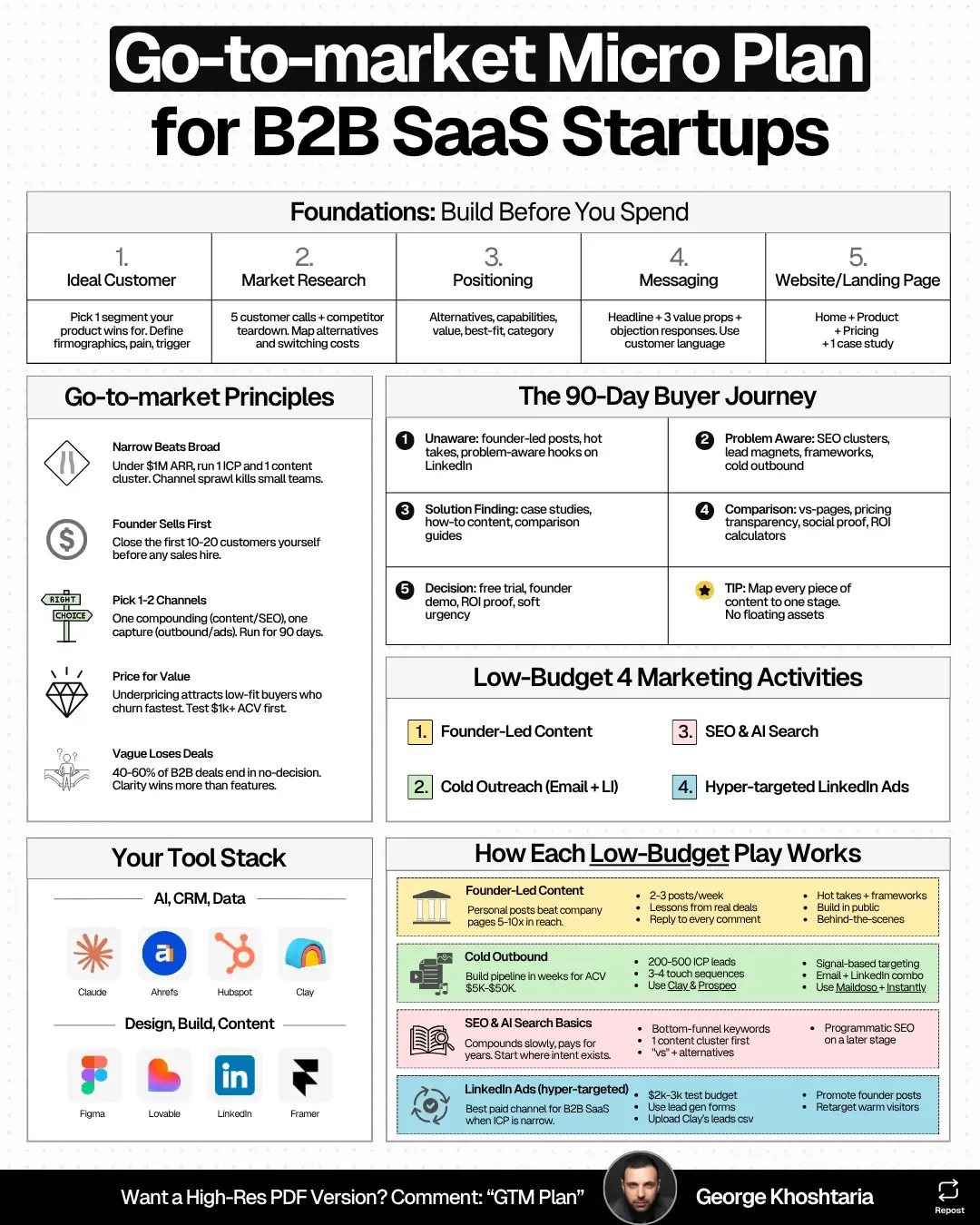
What Is a GTM Micro-Plan?
A GTM micro-plan is a deliberately constrained go-to-market system for early-stage B2B SaaS (typically under $1M ARR). It limits scope to one ICP, one to two acquisition channels, and a 90-day window to prove or kill each motion.
The goal is signal. Not scale.
Most early-stage founders run out of steam before they run out of money because they are trying to measure five channels at once with no baseline. A micro-plan forces a clean test: one channel, one audience, 90 days. If it generates pipeline, double down. If it does not, you have clean data on why.
Sidenote. This is not a "startup on a shoestring" tactic. It is the approach companies with proper funding use when they respect the cost of context-switching.
Step 1: Build the GTM Foundation Before You Spend on Channels
Spending on channels before your positioning is sharp just buys you faster confusion.
Get these five things right first. Founders regularly skip this step because it does not feel like "doing marketing." It is the part that makes the marketing work.
1. Define your ICP (go narrow)
Pick one segment where your product clearly wins. Define firmographics (company size, industry, region), the specific pain they have, and the trigger event that makes someone start looking for a solution.
For example: a 50–200 person SaaS company that just hired its first sales team and has no structured outbound process. The trigger is the hire. The pain is no pipeline system.
The narrower your ICP, the better your message converts. Research from multiple GTM practitioners consistently shows that 40–60% of B2B deals end in no-decision, and vague positioning is one of the leading causes. A sharp ICP is the antidote.
2. Run real market research
Five customer calls plus a competitor teardown is the minimum viable research.
Map the alternatives your buyers already use. What do they switch from? What keeps them from switching? What is the switching cost? You need this to write positioning that actually lands, not positioning that you invented in an internal workshop.
3. Nail your positioning
Positioning is not your tagline. It is the answer to four questions:
What alternatives do your buyers currently use?
What do you do that those alternatives do not?
What is the value of that difference for a specific buyer?
What category do you want to be measured in?
If you cannot answer all four clearly, your messaging will be soft, your ads will underperform, and your sales calls will drag on objections that could have been pre-empted.
4. Write your core messaging
A headline, three value props, and answers to your top three objections — all written in your customers' words, not yours.
The phrase "written in your customers' words" is doing a lot of work there. If your headline uses internal jargon your buyers do not use when searching for a solution, you are invisible on every channel.
5. Build a minimal landing page
You do not need a 40-page site. You need four things:
Home page with a clear headline and a single CTA
Product or features page
Pricing page
One case study or proof point
That is enough to convert inbound traffic and give cold outreach somewhere credible to point.
Tip. Put your positioning statement through this test: can your best customer read your homepage headline and immediately say "yes, that's me"? If not, rewrite it before you spend anything.
Step 2: Choose 2 of These 4 Low-Budget GTM Channels
You do not need a $50K budget. You need two channels that match how you actually sell.
Channel 1: Founder-Led Content
Personal LinkedIn profiles outperform company pages by roughly 5–10x for engagement and reach.
The mechanic is simple: the founder posts 2–3 times per week — real frameworks, hot takes from active deals, lessons from customer calls. Reply to every comment. This compounds over 6–12 months and costs nothing but time.
Best for: ACV of any range. Works faster at under $5K ACV where buyers do their own research. Compounds well alongside any other channel.
Channel 2: Cold Outbound
The fastest path to pipeline, and it works best when your ACV sits between $5K and $50K.
Build a list of 200–500 ICP-fit leads, prioritize by buying signals (job changes, tech installs, funding rounds), and run 3–4 touch sequences across email and LinkedIn. You can see results in 2–4 weeks, not quarters.
The key variables:
List quality matters more than sequence length. 300 well-qualified leads beat 2,000 scraped ones.
Personalization at the angle level, not the line level. Tailor the opening observation, not the whole email.
Follow-up is where most deals happen. 70%+ of replies come after the first touch.
Channel 3: SEO (Start at the Bottom of the Funnel)
SEO is a CAC-reduction play, not a first-revenue play.
It pays off over 6–12 months, so start where intent already exists. Target bottom-funnel keywords first: "[competitor] alternative", "[category] for [industry]", "[use case] software". These pages attract buyers already in purchase mode.
Pick one content cluster and own it before you expand. A site with 10 tightly focused posts on one topic ranks faster than a site with 50 posts on 15 topics.
Channel 4: Hyper-Targeted LinkedIn Ads
The best paid channel for B2B SaaS when your ICP is narrow enough to target precisely by job title, company size, and industry.
Start with a $2,000–$3,000 test budget. Promote your best-performing founder posts rather than polished company ads (they convert better because they look human). Retarget warm website visitors before expanding to cold audiences.
How to Match Your Channels to Your ACV
ACV Range | Sales Motion | Recommended Channels |
|---|---|---|
Under $5K (self-serve) | Product-led | Founder content + SEO |
$5K–$50K (founder-led) | Outbound sales | Cold outbound + founder content |
$50K+ (sales-led) | Enterprise sales | ABM + targeted outbound |
The rule: if your buyer does their own research, build channels that serve researchers (content, SEO). If your buyer needs to be found and convinced, build channels that reach them directly (outbound, ads).
Step 3: Your Lean GTM Stack
You can run this entire plan with under ten tools:
Research and content: Claude + Perplexity (research, drafting, positioning work), Ahrefs (keyword research and competitor gap analysis).
Prospecting and outbound: Clay + Prospeo (list building, data enrichment, buying signal detection).
CRM and automation: HubSpot (free tier covers early-stage needs), Zapier (automation between tools).
Website and design: Framer (fast, no-code website), Figma (design work), Lovable (interactive assets like ROI calculators).
No tool replaces positioning. No stack replaces an ICP. Every tool in this list is a multiplier on a foundation that already exists.
The 90-Day Execution Framework
Days 1–30: Foundation and launch
Complete the five-part GTM foundation (ICP, research, positioning, messaging, landing page)
Build your prospecting list for outbound
Publish your first 8–10 pieces of founder content
Set up tracking (UTMs, CRM, call recording)
Days 31–60: Volume and iteration
Send outbound sequences to your first 200 leads
Publish 2–3 pieces of content per week
Collect every objection, reply, and "not interested" response — this is your market research
Adjust messaging based on what you hear
Days 61–90: Evaluate and double down
Which channel produced replies, calls, or demos?
What message variation got the highest response rate?
Which ICP sub-segment responded fastest?
Kill what floated. Double the budget and time on what showed signal.
The 90-day window is not a deadline. It is a forcing function for a clean decision.
Sidenote. The most common reason the 90-day review produces no signal is mixing too many variables. If you changed your ICP, your message, and your channel simultaneously in month two, you cannot diagnose what shifted.
Frequently Asked Questions
What is the best go-to-market strategy for early-stage B2B SaaS?
Match your motion to your ACV. Under $5K and self-serve: go product-led plus content and SEO. For $5K–$50K ACV: founder-led sales plus cold outbound generates pipeline the fastest.
How many marketing channels should an early-stage SaaS run?
One to two. Under $1M ARR, channel sprawl is the most common cause of burnout and wasted budget.
How long before a GTM plan shows results?
Cold outbound and paid ads can produce pipeline in 2–4 weeks. Founder content and SEO compound over 6–12 months.
Do you need a big budget for B2B SaaS GTM?
No. The four channels above run primarily on time. A $2,000–$3,000 LinkedIn ads test is optional.
Why is a narrow ICP so important in go-to-market?
Research consistently shows that 40–60% of B2B deals end in no-decision, and vague positioning is a leading cause.
What is the difference between a GTM strategy and a GTM micro-plan?
A GTM strategy covers the full system: ICP, sales motion, pricing, channel mix, and revenue operations. A GTM micro-plan is the executable 90-day version.
Final Thoughts
A bigger budget does not win early-stage GTM. Focus does.
One ICP, two channels, and 90 days of disciplined execution beats five half-run channels every time. Map every activity to a single stage of the buyer journey. Kill what floats. Double down on the channel showing signal.
Start with the foundation. Pick two channels. Run the 90 days clean.
Subscribe to 1% GTM Insights

