
How to Position Your B2B SaaS Website to Sell to 3 Types of Buyers: CEO, CFO, CTO
How to Build a B2B SaaS Website That Arms Your Champion

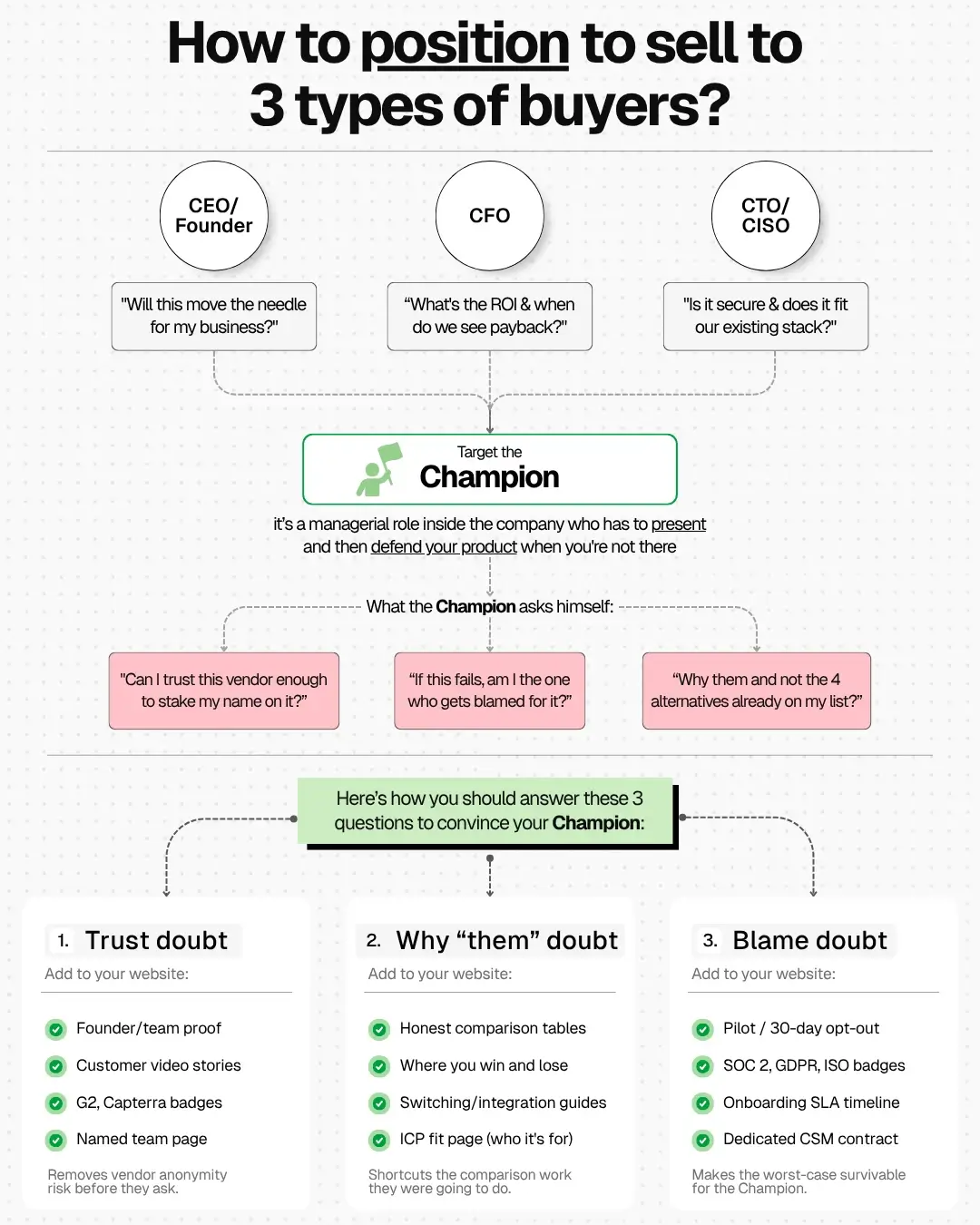
A B2B SaaS website built for champion enablement addresses three internal buyers (CEO, CFO, CTO) and kills the three doubts your Champion runs before they pitch anyone: trust doubt, why-you doubt, and blame doubt. It gives your Champion the one-pager, the ROI calculator, and the security brief they need to win approvals without you in the room.
Key takeaways
The primary job of a B2B SaaS website is not to convince the CEO. It is to arm your Champion to convince the CEO, CFO, and CTO without you in the room.
Before your Champion pitches anyone internally, they run three private doubts: trust doubt, why-you doubt, and blame doubt. If your website does not kill all three, the deal dies silently.
Your Champion has to satisfy three different lenses: the CEO wants business impact, the CFO wants ROI and payback, the CTO wants security and integration fit.
The fix is not more features copy. It is the right proof for each buyer: a one-pager for the CEO, an ROI calculator for the CFO, and a security brief for the CTO.
Deals that stall after the first demo almost always trace back to a Champion who ran out of internal ammo.
Most B2B SaaS websites are written for one buyer. The CEO, usually. Big headline, three value props, "Book a Demo" button.
But you are never selling to one buyer in B2B. The average mid-market SaaS deal involves 3 to 6 stakeholders, and enterprise deals regularly cross 6 to 10, according to Gartner's buying committee research. The person you spoke to on the demo is rarely the person who signs.
In this post, you will learn:
How the internal sales process actually works after your demo ends
What three doubts your Champion is privately running about you right now
How to build your website to kill each doubt before it kills the deal
The exact content each buyer (CEO, CFO, CTO) needs to say yes
How B2B Deals Actually Die (It Happens After the Demo)
You had a great first call. The Champion was enthusiastic. They said they would take it to the team.
Then: nothing. No email. No rejection. Just silence.
Here is what happened. Your Champion walked into an internal review and could not answer basic questions. The CEO asked about business impact. The CFO asked about ROI and payback period. The CTO asked about security certifications and integration with their stack. Your Champion had the enthusiasm but not the ammo.
According to Influ2's 2026 survey of enterprise and mid-market buyers, the top deal bottlenecks are budget approval (34%), internal alignment (22%), and security concerns (20%). All three map directly to the CEO, CFO, and CTO.
Sidenote. This is not a sales process failure. Most of the time, the Champion wants to buy. They just could not defend the purchase to three different people who each needed a completely different argument.
The Champion's Job (That Most Founders Forget Exists)
Your Champion is typically the manager or director who found you, tried your product, and decided it was worth staking their professional reputation on.
That last part matters. They are not just forwarding a link. They are personally vouching for you to people with veto power over their budget, their headcount, and sometimes their jobs.
Before they pitch anyone, they run a quiet internal audit on you. They will never say these doubts out loud. But they are running them.
Trust Doubt: "Can I stake my name on this vendor?"
Every Champion wonders whether you are credible enough to be worth defending. Vendor anonymity is a real risk. If your website has no team page, no named founder, no real customer stories, and no third-party validation, you look like a risk.
Why-You Doubt: "Why this product and not the four alternatives already on my list?"
Your Champion already knows your category. They have probably evaluated two or three competitors before they even spoke to you. If they cannot articulate clearly why you win, they will either drop you or stall indefinitely.
Blame Doubt: "If this fails, is this my fault?"
This is the doubt nobody talks about in B2B marketing. If the implementation goes poorly, who gets blamed? The Champion does. If your website does not make the worst-case scenario survivable, you are asking them to absorb risk they cannot quantify.
How to Build a Website That Kills All Three Doubts
Kill the Trust Doubt: Remove Vendor Anonymity Risk
Founder and team proof on the homepage. Not just logos. Real people, real roles, real faces. A one-line bio showing relevant experience.
Customer video stories, not just logo walls. A 90-second video of a customer director saying "here's the specific problem we had and here's what changed" is worth 20 logos.
G2 and Capterra review badges visible in the footer. Third-party validation signals peer confirmation.
Named team page with real roles. Especially relevant if you are selling into security-conscious or enterprise accounts.
Tip. Go to your own homepage right now. If a mid-level manager sent it to their CFO, would the CFO feel confident or confused about who you are?
Kill the Why-You Doubt: Make the Comparison Work Easy
Honest competitor comparison tables. Name the alternatives your buyers actually consider. Show where you win and where you do not.
An ICP fit page that says who you are NOT for. This filters out bad-fit prospects and signals genuine self-awareness.
Switching and integration guides. "How hard is it to get started?" is the question Champions field before any CTO conversation.
Clear category positioning. Your Champion needs to describe you in one sentence to someone who has never heard of you.
Kill the Blame Doubt: Make the Worst Case Survivable
Pilot program with a 30-day opt-out. Converts the purchase from an irreversible commitment to a reversible test.
SOC 2, GDPR, ISO certifications visible above the fold on your security page. Not buried in the footer, with actual certification documents downloadable.
Onboarding SLA with real dates. Specific commitments, not vague reassurance.
Dedicated CSM or support contact written into the contract. A named commitment for the first 90 days.
The Three Buyers Your Champion Has to Convince
The CEO: "Will this move the needle for the business?"
What your website needs: a business impact one-pager, case studies framed around business results (not product features), and a clear answer to "what does success look like at 90 days?"
The CFO: "What's the ROI and when do we see payback?"
What your website needs: an ROI calculator with real inputs, transparent pricing (or at minimum a range), and customer ROI data with specific numbers.
The CTO or CISO: "Is it secure and does it fit our stack?"
What your website needs: a dedicated security and compliance page (SOC 2 Type II, GDPR, ISO 27001), an integration list with logos and setup guides, and a data handling FAQ.
Recommendation. Create a "Security Brief" PDF — one page, all certifications, data storage details, breach notification process, and a link to your full security page. This is the document your Champion forwards directly to the CTO or CISO.
What "Champion-Enabled" Looks Like in Practice
Website element | Standard SaaS site | Champion-enabled site |
|---|---|---|
Homepage headline | Features-led or category claim | Business outcome for the ICP |
Social proof | Logo wall | Customer video stories + review badges |
Team/about page | Generic "our mission" | Named founder + team with real credentials |
Competitor comparison | None | Honest table with named alternatives |
Security page | Footer link to a sparse page | Dedicated nav item, downloadable certs |
Pricing | "Contact us" | Range or calculator with payback output |
Resources | Blog only | Business impact one-pager, ROI calculator, security brief |
Risk handling | "30-day free trial" | Pilot program with explicit opt-out terms |
Frequently Asked Questions
What is a Champion in B2B SaaS sales?
A Champion is the internal buyer who found your product, advocates for it internally, and personally vouches for it to budget holders and technical approvers. According to Gartner's buying committee research, the average B2B buying group includes 6 to 10 stakeholders.
Why do B2B deals stall after the first demo?
Deals stall because the Champion cannot answer internal objections alone. The top deal bottlenecks are budget approval (34%), internal alignment (22%), and security concerns (20%), according to Influ2's 2026 buyer survey.
What should a B2B SaaS website include to support internal selling?
At minimum: a business impact one-pager for the CEO conversation, an ROI calculator for the CFO conversation, and a downloadable security brief for the CTO or CISO conversation.
What are the three doubts every B2B Champion runs before pitching internally?
Trust doubt, why-you doubt, and blame doubt. These doubts are almost never said out loud. If your website does not kill all three, the Champion never reaches the internal pitch stage.
How do you write B2B SaaS website copy for multiple buyers?
Do not try to write one headline that resonates with everyone. Route each buyer to a dedicated page or section that speaks their language.
What is champion enablement in B2B marketing?
Champion enablement is the practice of giving your internal buyer the tools, content, and evidence they need to sell your product on your behalf inside their organization.
Final Thoughts
Your website is not a brochure. It is a sales rep that works the account while you sleep, and specifically, while your Champion is defending you in meetings you were never invited to.
The founders who build pipeline fastest are the ones whose Champion can walk into a CEO, CFO, and CTO conversation with a specific piece of evidence for each one, all sourced from the vendor's own website.
Build for the Champion. Arm them for three different rooms. Win the deal.
Subscribe to 1% GTM Insights

